Degraded oil heats slowly, cokes the jacket and can split a heater tube. What our engineers' report says about changing it, and why a fresh fill sometimes overflows.
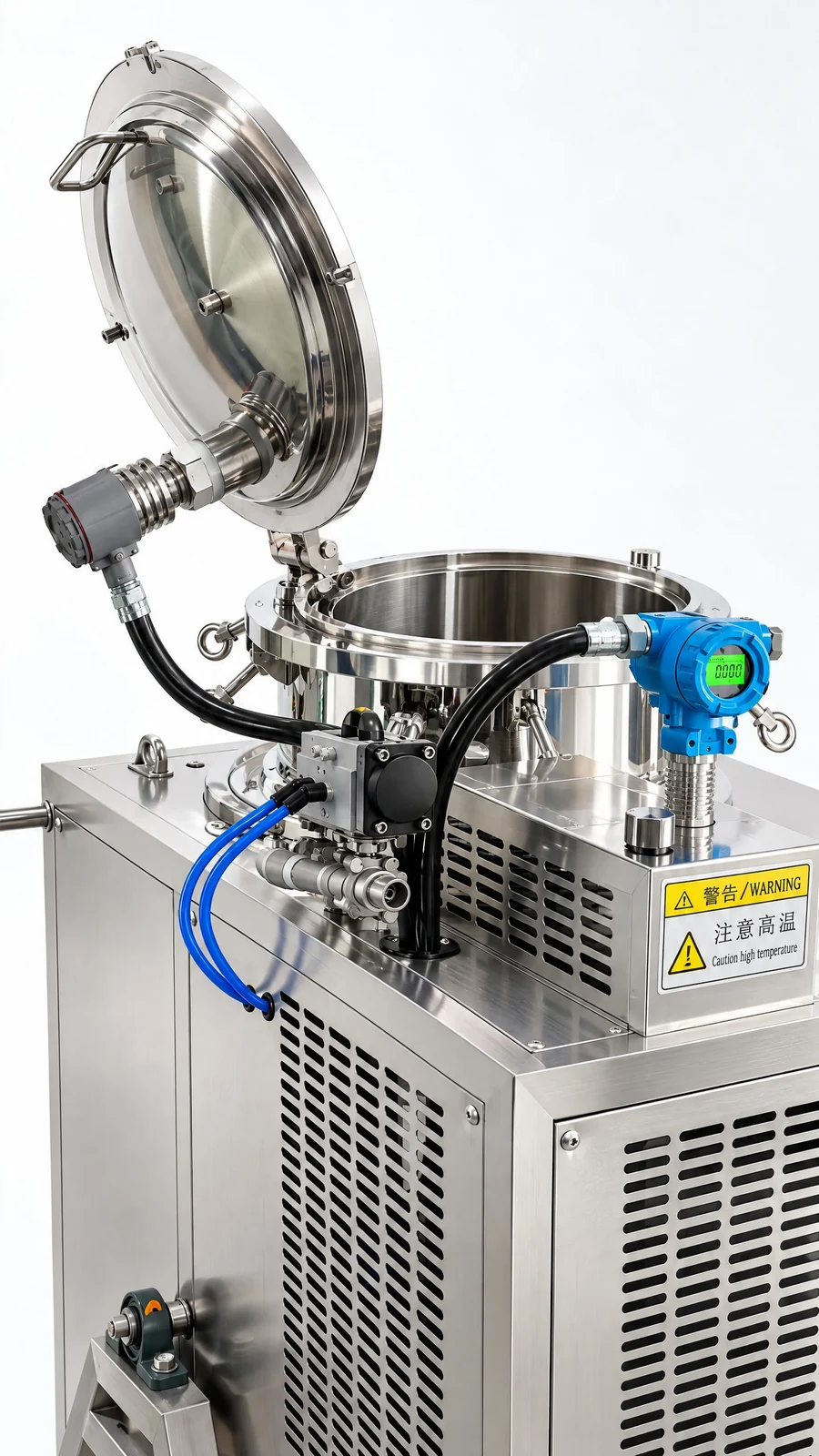
The oil in the jacket is the part of the machine nobody looks at. It decides both the throughput and how safe the machine is to stand next to.
Why it degrades
Heat-transfer oil breaks down continuously while it carries heat at temperature, and the rate rises with the operating temperature: hotter running means faster degradation. Our maintenance schedule is a change every 1,000 operating hours, or every six months, whichever comes first.
What a late change costs
- Throughput. Degraded oil conducts worse. The machine heats more slowly, the batch takes longer, and the recovery rate falls.
- Fire risk. The oil is not itself flammable, but kept at temperature past its life it lays down carbon. A leak that reaches a flame then has something to burn.
- Overpressure. Carbon settles on the heated bottom of the tank and in the jacket between the inner and outer shell. Blocked passages push the pressure inside the tank up.
- Heater tubes. Carbon scale clings to the tube and insulates it. Heat cannot leave the tube, and eventually the tube splits. Replacing one is expensive and stops production.
The overflow after a change
Some machines push oil out of the overflow early after a fresh fill. Oil expands as it heats; if the fill was estimated generously, the excess has to go somewhere. It is a physical effect, not a fault: after three or four normal batches the level settles and the overflow stops.
A drum of oil costs less than a heater tube, a lost batch, or a fire report.